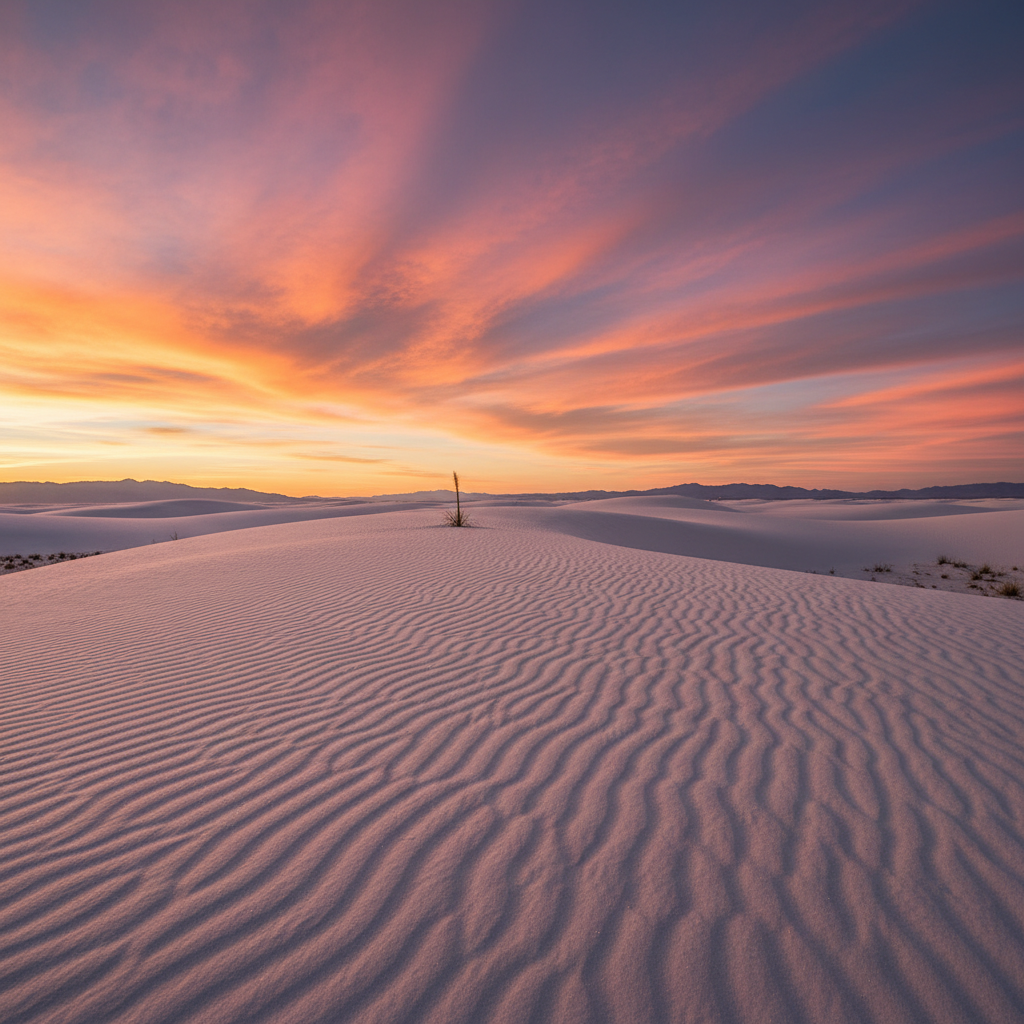
The world's largest gypsum dunefield, preserving 275 square miles of cool, wave-like white sands in New Mexico's Tularosa Basin.
White Sands National Park preserves the world's largest gypsum dunefield, a glistening expanse of 275 square miles in the heart of New Mexico's Tularosa Basin. Unlike typical desert dunes composed of quartz, these rolling waves are made of pure, soft gypsum, a mineral that remains cool to the touch even under the intense desert sun. The landscape is a stark, blinding white that stretches to the horizon, framed by the dark ridges of the San Andres Mountains to the west and the Sacramento Mountains to the east. Established as a national monument in 1933 by President Herbert Hoover and redesignated as a national park in 2019, this protected area is entirely surrounded by the active military installations of the White Sands Missile Range, creating a surreal juxtaposition of ancient natural wonders and modern aerospace testing.
The geologic story of the basin began roughly 250 million years ago when a shallow sea deposited thick layers of gypsum. During the last Ice Age, a massive body of water known as Lake Otero filled the basin, collecting dissolved gypsum from the surrounding mountains. As the climate warmed and the lake evaporated, it left behind a vast dry lakebed, the Alkali Flat, and a smaller, seasonal playa called Lake Lucero. Strong prevailing winds broke down the exposed selenite crystals into fine, powdery grains, carrying them northeast to form the massive, shifting dunes that rise up to 60 feet high. Within this seemingly inhospitable environment, life has adapted in extraordinary ways. The soaptree yucca grows elongated stems to keep its leaves above the advancing sand, while endemic species like the Apache pocket mouse and the bleached earless lizard have evolved pale coloration to blend seamlessly with the white gypsum.
Human history is etched deeply into this landscape, stretching back more than 21,000 years. Fossilized footprints preserved in the clay of the ancient lakebed record the movements of Ice Age humans walking alongside Columbian mammoths and giant ground sloths, providing some of the earliest evidence of human presence in North America. Later, nomadic hunter-gatherers and the agricultural Jornada Mogollon people utilized the basin, followed by the Mescalero Apache, who fiercely defended their ancestral homeland and continue to maintain deep cultural ties to these dunes. Today, visitors can experience the park by driving the scenic 16-mile Dunes Drive, walking the elevated Interdune Boardwalk, or hiking the five-mile Alkali Flat Trail into the silent heart of the dunes. Sliding down the steep slopes on plastic saucers is a classic park pastime, while staying until twilight reveals a dramatic transformation as the white sand catches the setting sun, shifting through shades of lavender, pink, and deep gold before the desert stars emerge.
Purchase a plastic snow saucer at the visitor center gift shop for sledding down the dunes, and remember to wax the bottom for maximum speed. Always check the park's website before visiting, as missile tests at the surrounding White Sands Missile Range can close Dunes Drive for up to three hours.