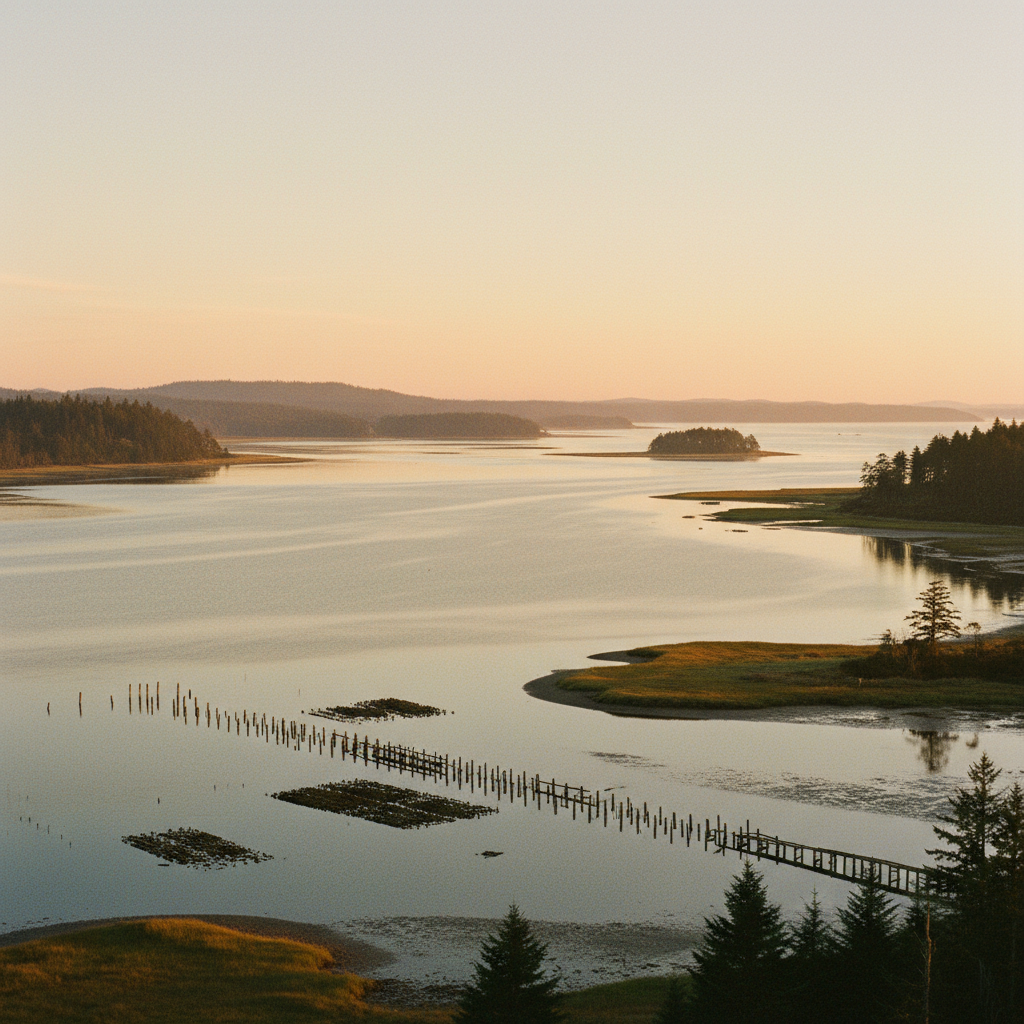
Salty air hangs heavy over Willapa Bay, where tide-scoured flats surrender a quarter of the country's oysters, their briny scent mingling with the cries of gulls.
Drive west past the timber of the Willapa Hills and the landscape opens into a massive, silver-grey expanse of water and sky. The air over Willapa Bay changes instantly: it is cold, thick with salt, and heavy with the sharp scent of decaying sea grass and exposed mud. At high tide, the bay is a vast, wind-whipped inland sea, bordered by the dark pine forests of the Long Beach Peninsula. At low tide, the water drains to reveal miles of glistening mudflats, a labyrinth of deep channels, and thousands of wooden stakes marking the oyster beds. The dominant sound is the high, lonely piping of shorebirds and the low rumble of diesel engines from the oyster scows. This is one of the cleanest estuaries in North America, a place where the boundary between land and water is constantly dissolving.
This shallow basin is fed by several rivers, including the Naselle, Willapa, and Nemah, which mix with the icy tides of the Pacific. For generations, the Shoalwater Bay Tribe and the Chinook people lived along these shores, harvesting native Olympia oysters. In the mid-nineteenth century, during the California Gold Rush, schooners arrived to harvest these oysters for San Francisco, leading to the boomtown of Oysterville. When native oysters were depleted, growers introduced the Pacific oyster, which thrived in these cold waters. Today, this bay produces about one-quarter of all oysters harvested in the United States. The surrounding marshes of the Willapa National Wildlife Refuge also serve as a critical stopover on the Pacific Flyway, hosting thousands of migrating shorebirds each season.
Exploring Willapa Bay requires aligning yourself with the tides. A drive along the quiet eastern shore on Highway 101 or up the peninsula through Nahcotta reveals a working waterfront that has changed little in a century. You can watch flat-bottomed oyster boats, piled high with grey shells, unload their catch at historic docks while gulls circle overhead. The best way to experience the bay is to eat it: stopping at a roadside shack in Bay Center or Nahcotta to buy oysters shucked minutes prior, their flavor a clean, cold burst of cucumber and ocean brine. In the late afternoon, when the tide is low, the wet mudflats turn to sheets of hammered gold, reflecting the sky. It is a landscape of quiet, industrious beauty, shaped by the slow, ancient pulse of the tide.
For the ultimate tasting experience, head to the historic village of Oysterville on the peninsula or the tiny enclave of Bay Center on the eastern shore. Buy freshly shucked Pacifics directly from the growers, grab a shucking knife, and head to the water's edge. Time your visit with a receding tide to watch the oyster boats navigate the shallow channels.