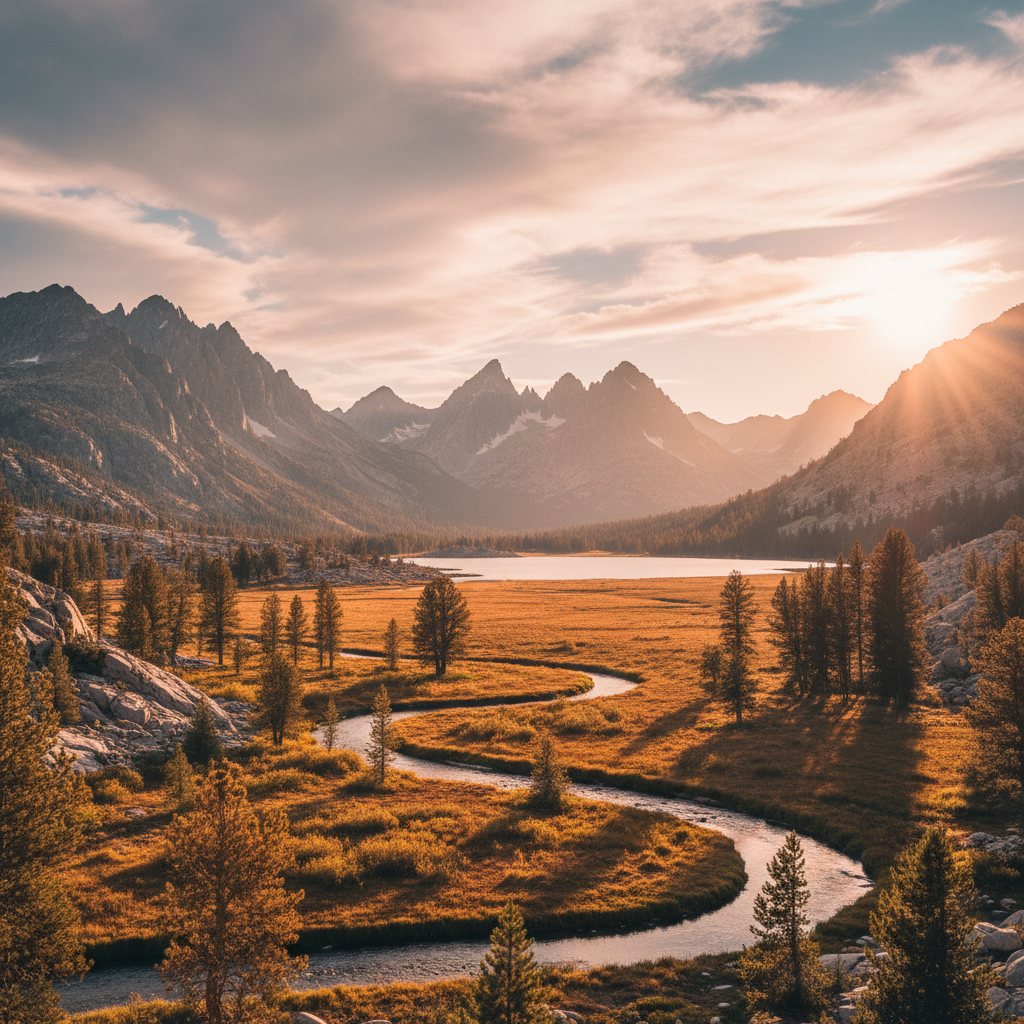
Traverse a high-altitude sanctuary of jagged metavolcanic peaks, subalpine meadows, and glacier-fed lakes immortalized by its namesake photographer.
The Ansel Adams Wilderness is a 231,533-acre sanctuary of dark, jagged peaks and alpine lakes that straddles the crest of California's Sierra Nevada. Originally designated as the Minarets Wilderness under the Wilderness Act of 1964, it was expanded and renamed in 1984 to honor the legendary landscape photographer Ansel Adams, whose black-and-white images brought this rugged terrain to national consciousness. Spanning elevations from 3,500 feet to the 13,157-foot summit of Mount Ritter, the wilderness is defined by the Ritter Range. Unlike the pale granite domes typical of the surrounding High Sierra, this subrange is composed of Mesozoic metavolcanic rock, an ancient roof pendant that was spared by the surrounding batholith. This dark, iron-rich metamorphic rock gives the jagged spires of the Minarets and the massive block of Banner Peak their brooding, dramatic appearance.
The area's human history is deeply woven into the landscape. Long before modern backpackers arrived, the Owens Valley Paiute (Numu) and Western Mono (Monache) peoples traveled these high passes to trade obsidian, acorns, and pine nuts. Today, modern travelers trace these ancient trade routes along the John Muir Trail, traditionally called Nüümü Poyo (the People's Trail), which runs parallel to the Pacific Crest Trail through the heart of the wilderness. These paths lead to a constellation of iconic alpine basins, including Thousand Island Lake, Garnet Lake, Shadow Lake, and Ediza Lake. Thousand Island Lake, sitting at 9,833 feet, is particularly famous, guarded by the massive, 12,945-foot north face of Banner Peak. Here, small granite islets dot the water, catching the early morning light in a scene that Adams famously captured on his early photographic expeditions.
The wilderness is home to a rich array of subalpine ecology, where the sharp scent of sun-baked lodgepole and whitebark pines fills the thin air. High-elevation talus slopes provide habitat for the high-pitched chirps of American pikas, while mule deer and black bears roam the lower meadows. In July and August, the melting snowpack feeds vibrant displays of Sierra paintbrush, lupine, and shooting stars, though hikers must prepare for heavy mosquito hatches. By September and October, the insects vanish, the air turns crisp, and the subalpine grasses turn deep amber, providing a quiet window for exploration before winter snows bury the trails under several feet of pack. Overnight stays in the wilderness require wilderness permits, managed by the U.S. Forest Service through Recreation.gov, with trailheads split between the Inyo National Forest on the eastern slope and the Sierra National Forest on the western slope.
For a classic Sierra sunrise, camp along the eastern shore of Thousand Island Lake and begin hiking toward Island Pass an hour before dawn. As the sun crests the eastern horizon, it ignites the dark metavolcanic face of Banner Peak in a brilliant, fiery alpenglow, reflecting perfectly in the still alpine water.