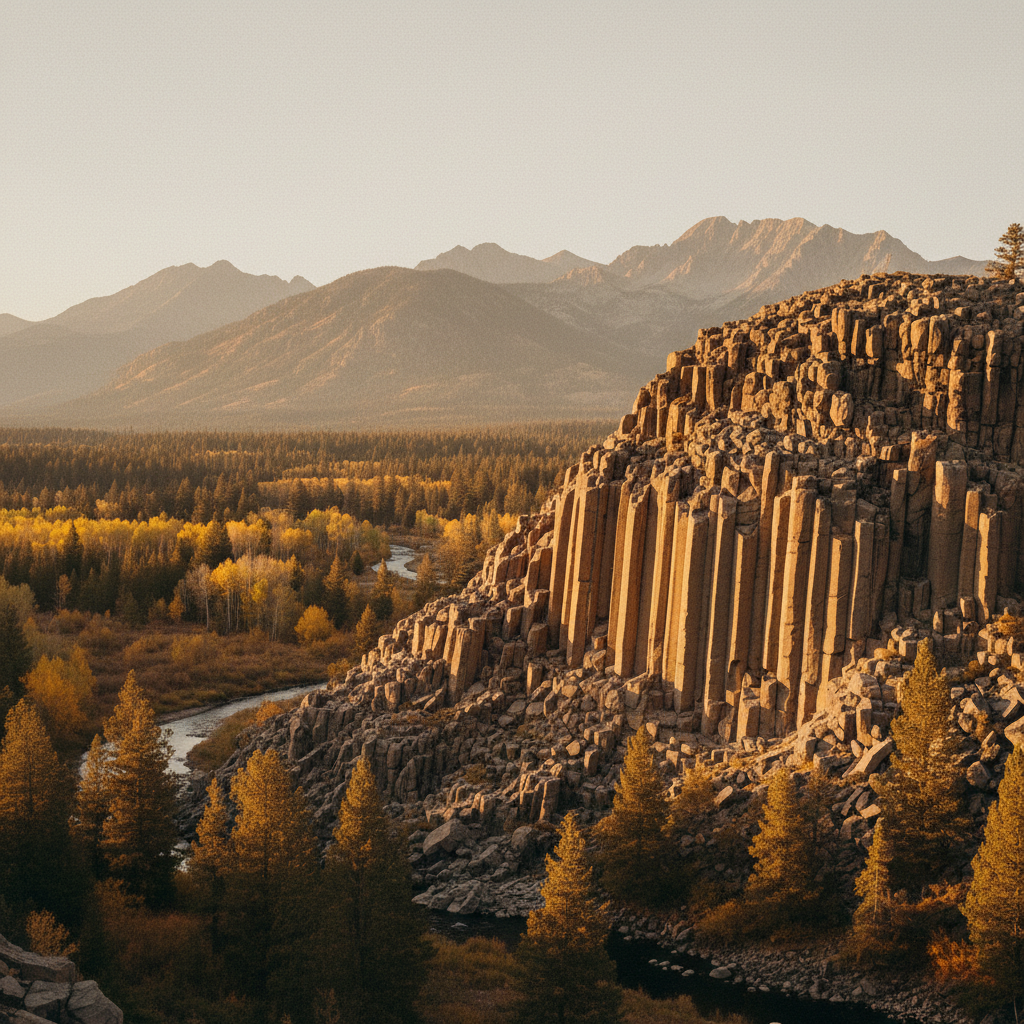
Devils Postpile National Monument protects a sheer 60-foot cliff of near-perfect hexagonal basalt columns and the dramatic 101-foot Rainbow Falls.
Devils Postpile National Monument preserves one of the world's most striking examples of columnar basalt, a geometric wonder forged by fire and polished by ice on the western slope of the Sierra Nevada. The monument, encompassing 798 acres of wilderness, centers on a sheer, 60-foot cliff of symmetrical, hexagonal basalt columns that resemble a colossal pipe organ. This geological marvel originated roughly 82,000 years ago when a massive flow of hot basaltic lava pooled in the valley, creating a lava lake up to 400 feet deep. As the lava cooled slowly and evenly, it contracted and cracked into systematic, vertical columns averaging two feet in diameter. Thousands of years later, during the late Pleistocene epoch, a massive glacier flowed down the Middle Fork of the San Joaquin River, overriding the fractured lava. The moving ice sheared away one side of the formation to expose the vertical columns we see today, while polishing the top of the postpile into a smooth, glittering mosaic of hexagonal cross-sections that resemble a hand-laid tile floor, complete with parallel grooves carved by rock-studded glacial ice.
The preservation of this landscape is a triumph of early American conservation. Originally included within the boundaries of Yosemite National Park in 1890, the area lost its federal protection in 1905 when local mining and timber interests pressured the government to redraw the park boundaries. Shortly thereafter, engineers proposed a plan to blast the basalt columns into the river to construct a hydroelectric rock dam. This threat galvanized prominent conservationists, including John Muir and Joseph N. LeConte, who petitioned the federal government to intervene. Their efforts succeeded when President William Howard Taft signed a presidential proclamation on July 6, 1911, establishing the area as a national monument. Today, the monument remains surrounded by the pristine expanse of the Ansel Adams Wilderness, serving as a vital corridor where the Pacific Crest Trail and the John Muir Trail merge, allowing hikers to tread the same paths that early conservationists fought to protect.
Beyond the central basalt formation, the monument protects a two and a half mile stretch of the Middle Fork of the San Joaquin River, which culminates in the dramatic plunge of Rainbow Falls. Here, the river drops 101 feet over a sheer cliff of dark volcanic rock, sending up a constant cloud of mist that regularly refracts the afternoon sun into its namesake rainbow. Visitors can access both the postpile and the falls via a network of well-maintained trails starting near the ranger station. Because of the fragile subalpine ecosystem and high visitation, access to the monument is managed via a mandatory shuttle bus system during the peak summer season, departing from the Mammoth Mountain Main Lodge. This transit system reduces vehicle emissions and protects the narrow mountain roads, ensuring that the quiet, pine-scented valley remains as pristine as it was when Taft first granted it federal protection over a century ago.
Check the latest road construction schedule before visiting, as Reds Meadow Road undergoes major reconstruction with weekday closures. When the road is open, you can bypass the mandatory shuttle by driving in before 7:00 a.m. or after 7:00 p.m., though you must still pay the standard valley amenity fee. To catch the namesake rainbow at Rainbow Falls, time your hike so you arrive at the falls overlook between 11:00 a.m. and 1:00 p.m., when the midday sun hits the mist at the perfect angle.