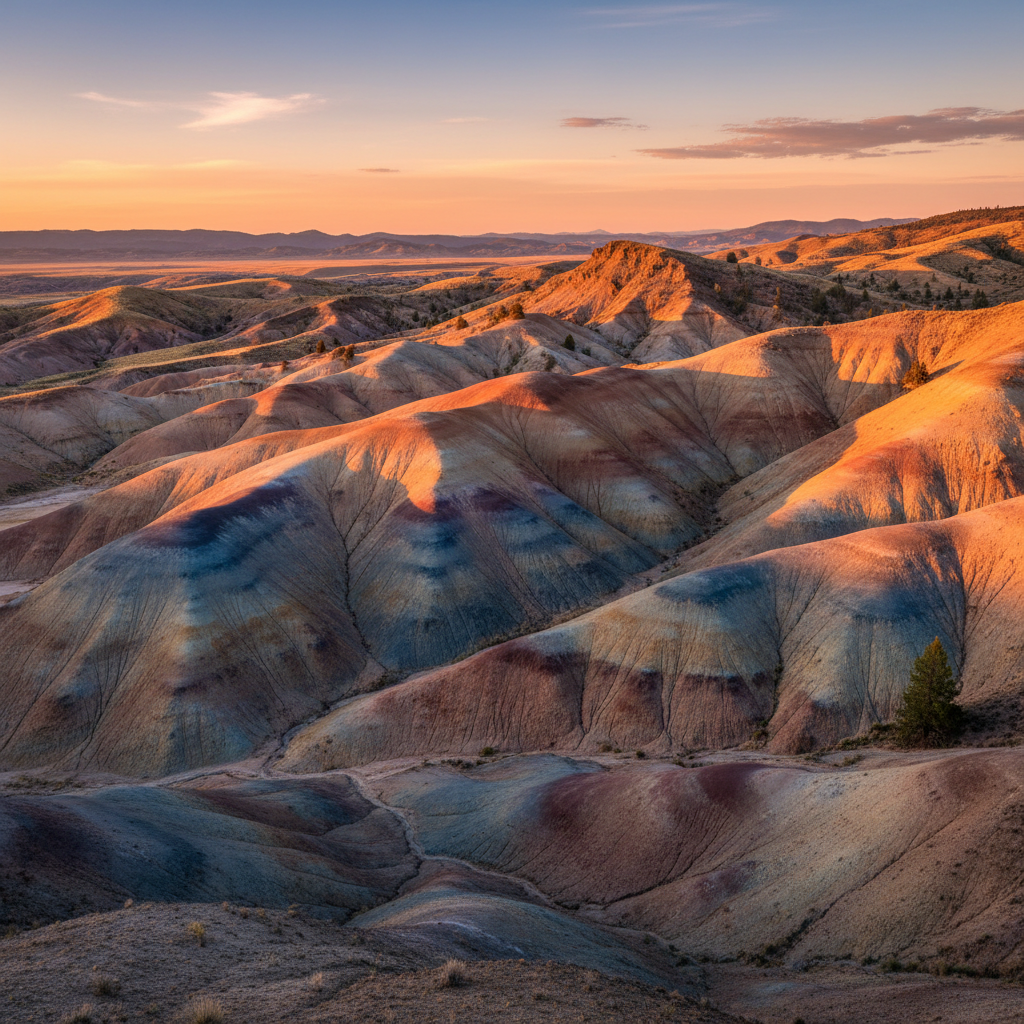
A towering, seafoam-green volcanic amphitheater in the Sheep Rock Unit.
Blue Basin, situated within the Sheep Rock Unit of the John Day Fossil Beds National Monument, is a dramatic, deeply eroded volcanic amphitheater defined by its striking pale blue-green claystone. Though often confused with the Painted Hills Unit located roughly 50 miles to the west, this distinct geological marvel lies along Oregon Route 19, just north of the Thomas Condon Paleontology Center. The towering, fluted badlands of the basin present an otherworldly landscape of rounded ridges and deep ravines carved by water over millennia. The vibrant seafoam color of the claystone is the result of millions of years of chemical weathering, where ancient volcanic ash from eruptions of the Crooked River Caldera and the Western Cascades was altered into green-hued minerals like celadonite and clinoptilolite.
The paleontological significance of this natural bowl dates back to the 1860s when Thomas Condon, a Congregationalist minister and avid geologist, first explored the area. He was so captivated by the abundance of fossils that he named the surrounding valley "The Cove," now known as the Turtle Cove Member of the John Day Formation. Condon's discoveries soon attracted the attention of rival paleontologists Edward Drinker Cope and Othniel Charles Marsh, who sent collectors to prospect these very slopes during their famous Bone Wars of the 1870s. The fossil beds here represent a highly preserved slice of the Oligocene epoch, roughly 29 million years ago, when this now-arid high desert was a warm, humid, semi-tropical forest. Within these layers, scientists have unearthed a prehistoric menagerie, including early three-toed horses like Miohippus, sheep-like oreodonts, giant pig-like entelodonts, and cat-like nimravids.
Visitors can explore the basin through two distinct trails that showcase its unique geology from different perspectives. The Island in Time Trail is a 1.3-mile out-and-back path that gently climbs about 200 feet along the canyon floor, crossing several metal grate bridges over a seasonal stream. This trail leads directly into the heart of the amphitheater and features interpretive signs alongside three fossil replicas, including an ancient land tortoise, preserved in situ under protective clear domes. Because of the metal grate bridges, hiking with dogs is not recommended on this trail as the grates can injure their paws. For a more demanding trek, the 3.25-mile Blue Basin Overlook Trail climbs 760 feet to the rim of the canyon. Navigating this loop, preferably clockwise, rewards hikers with a panoramic view of the intricate badlands below and the wide expanse of the John Day River Valley.
Plan your visit for the late afternoon when the low sun deepens the seafoam hues and casts dramatic shadows across the fluted claystone. If hiking with a dog, be aware that the metal grate bridges on the Island in Time Trail can burn or cut their paws, making the unshaded Overlook Trail a better option, provided you bring plenty of water.