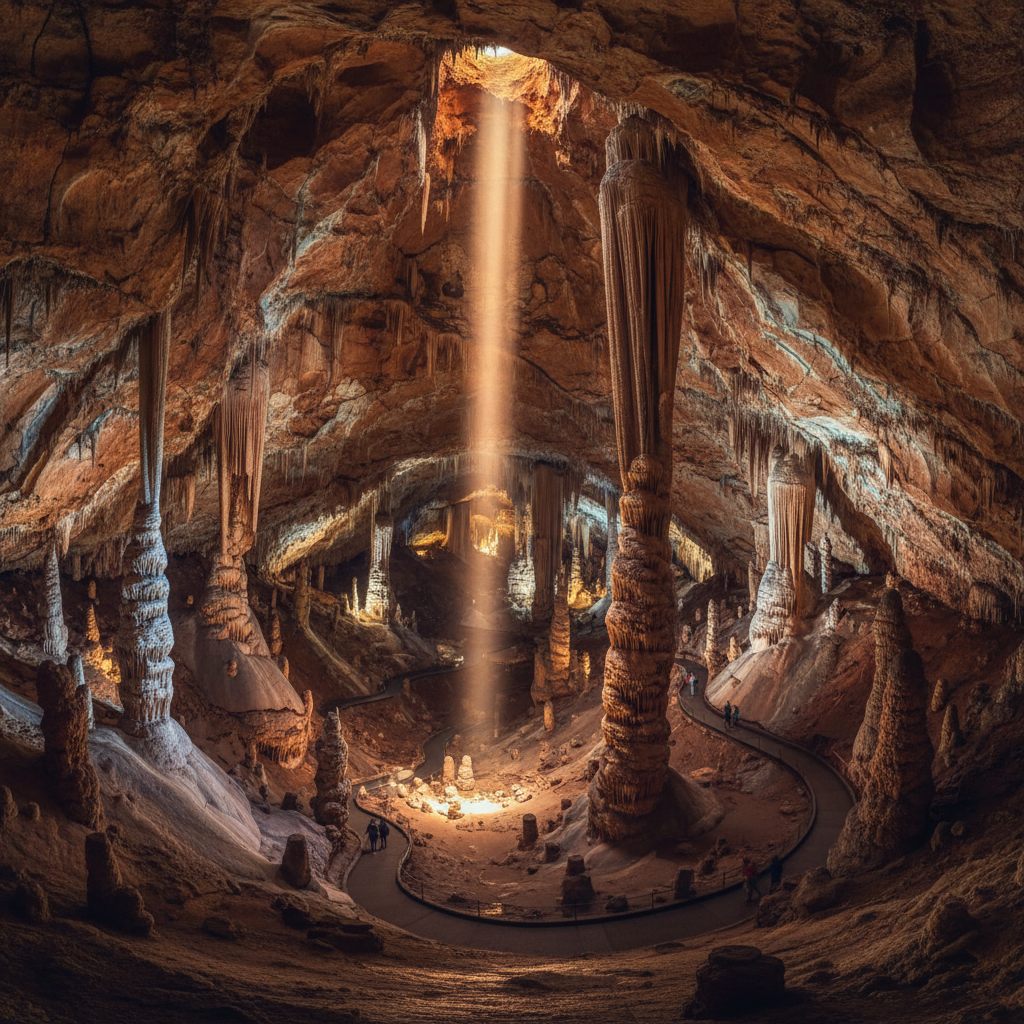
Hundreds of thousands of bats spiral out at dusk from this subterranean labyrinth, home to North America's largest single cave chamber by volume.
Carlsbad Caverns National Park preserves a vast underworld of more than 119 known limestone caves lying beneath the Chihuahuan Desert of southeastern New Mexico. Long before European settlers arrived, Indigenous peoples left their mark near the cave mouth, where ancient mescal-roasting pits and red-and-black pictographs still sit. The Mescalero Apache knew the cavern as Jadnut’udebiga, meaning Home of the Bat, while the Zuni Pueblo called it Asho:sti an alaluckwa, or Bat Cave. In 1898, a sixteen-year-old cowboy named Jim White spotted what he thought was a plume of smoke rising from the hills. Riding closer, he discovered a swirling volcano of hundreds of thousands of Brazilian free-tailed bats boiling out of a massive opening. Armed with a homemade wire-and-slat ladder, a kerosene lantern, and a ball of string, White became the first modern explorer to map these subterranean chambers, which were eventually designated a National Monument in 1923 and a National Park in 1930.
The geology of Carlsbad Cavern is highly unusual compared to most of the world's cave systems. Rather than being carved by carbonic acid from surface rainwater, these immense chambers were dissolved from the bottom up by sulfuric acid. Millions of years ago, hydrogen sulfide gas migrated upward from deep oil and gas deposits in the Permian Basin, mixing with oxygen-rich groundwater to create a highly corrosive acid that ate away at the ancient Capitan Reef, a fossilized marine reef from the Permian period. This process left behind monumental voids, including the Big Room, which stands as the largest single cave chamber by volume in North America. Spanning 8.2 acres, the Big Room stretches 4,000 feet long, 625 feet wide, and reaches heights of 255 feet. Within this cathedral-like space, mineral-rich water has dripped for millennia, depositing calcite, aragonite, and gypsum to create massive columns, delicate soda straws, and towering formations like the Giant Dome, the Temple of the Sun, and the Frozen Waterfall.
Exploring the cavern today begins either with a quiet elevator ride from the visitor center or a steep descent down the Natural Entrance trail. The Natural Entrance route drops 750 feet (equivalent to a 75-story building) along a paved, 1.25-mile path that winds into the damp, shadowed depths where the temperature remains a constant 56 degrees Fahrenheit (13 degrees Celsius) year-round. At the bottom, visitors can connect with the 1.25-mile Big Room loop, which provides a relatively flat, paved path through the heart of the cavern's most famous formations. For those seeking deeper exploration, ranger-led tours occasionally venture into more delicate chambers like King's Palace, a series of highly decorated rooms located 830 feet below the surface. From late spring through early autumn, the park's historic bat flight amphitheater hosts gatherings at dusk to watch the descendants of the same Brazilian free-tailed bats Jim White saw, spiraling out of the cave entrance in a silent, undulating ribbon to hunt over the Black River valley.
Reserve cavern entry tickets online well in advance. Wear sturdy, closed-toe shoes and pack a light jacket, as the cave remains a damp 56 degrees Fahrenheit (13 degrees Celsius) year-round. If you stay for the evening bat flight, leave all electronic devices, including cameras and cell phones, in your vehicle or turned completely off, as the park strictly prohibits them to protect the bats' navigation.