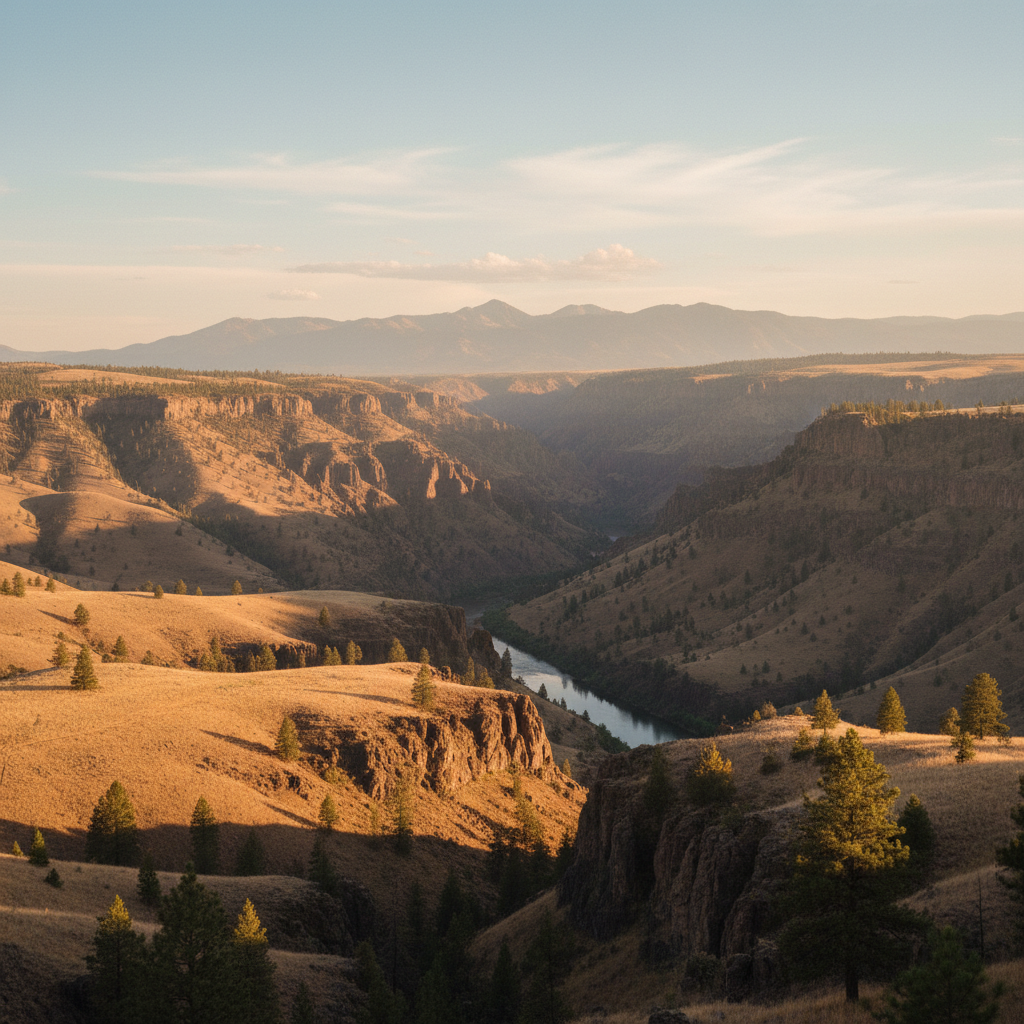
The Snake River carves North America's deepest gorge, a dramatic chasm where raw geology meets stark, wild beauty on the Oregon-Idaho border.
To stand on the rim of Hells Canyon is to confront a landscape of violent scale, measured in vertical miles. This is not a gentle valley but a profound, jagged rift in the earth, plunging deeper than the Grand Canyon. At the edge, the air smells of sun-baked ponderosa pine. Your eyes struggle to process the sheer drop to the Snake River, which appears from above as a narrow, coiled ribbon of jade and white foam. Across the chasm, the jagged peaks of the Seven Devils Mountains rise like dark teeth against the Idaho sky. It is a raw, intimidating threshold that immediately makes you feel small, standing at the edge of a continent split wide open.
This massive chasm, spanning over 650,000 acres of wilderness, was carved over millennia by the relentless force of the Snake River cutting through layers of ancient basalt. These volcanic flows stack upon one another like pages of a colossal manuscript, revealing millions of years of tectonic upheaval. Long before homesteaders and miners tried to scratch out a living here, this was the ancestral homeland of the Nimiipuu (Nez Perce). Their connection to this landscape is still written on the canyon walls, where ancient petroglyphs are etched into water-polished rocks near historic winter camps. The canyon acts as an ecological elevator: while the high rims support cool alpine forests, the depths of the gorge host a near-desert environment where summer temperatures regularly soar past one hundred degrees.
Experiencing Hells Canyon requires committing to its terms, whether you descend by foot or by water. On the river, the atmosphere is defined by the roar of rapids like Wild Sheep and Granite Creek, where the Snake River crashes through narrow chutes of black rock. Drifting through calmer pools, the canyon walls rise thousands of feet straight out of the water, leaving you in a quiet cathedral of stone. On land, rugged trails like the Snake River National Recreation Trail wind along the riverbanks, passing abandoned homesteads and old orchards. As evening approaches, the harsh midday glare softens: the low sun paints the Idaho side in brilliant shades of rust and gold, while the deep recesses of the gorge pool with violet twilight. It is a place of absolute isolation, where you are left with the ancient, steady pulse of the river.
For the most dramatic view without a multi-day river commitment, drive to the Hells Canyon Overlook on the Oregon side for sunrise. The low-angle light ignites the Seven Devils Mountains in Idaho and reveals the canyon's staggering depth before the daytime haze sets in. In late spring, the surrounding hills are carpeted in wildflowers, adding a fragile beauty to the immense scale.