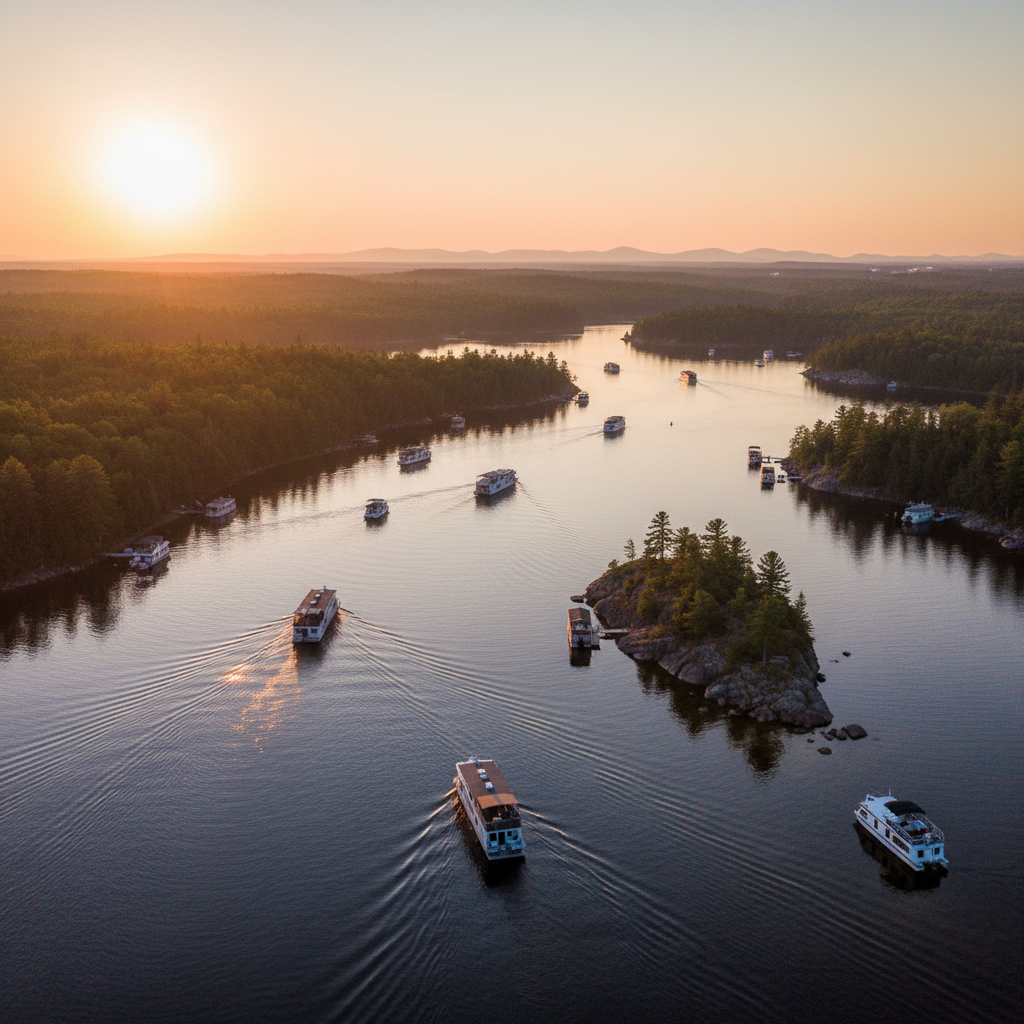
A water-based wilderness of glacial lakes, pine-crowned islands, and historic waterways along the Canadian border.
Voyageurs National Park is a vast, water-based wilderness spanning 218,000 acres along the border of Minnesota and Ontario. Unlike typical national parks designed for cars, this park is defined by its waterways, where roughly 40 percent of the total area is composed of interconnected lakes and channels. The heart of the park is the Kabetogama Peninsula, a remote landmass surrounded by four major lakes: Rainy Lake (known in Ojibwe as Gojiji-zaaga'igan), Kabetogama Lake (Gaa-biitoogamaag-zaaga'igan), Namakan, and Sand Point. Navigating these waters reveals a labyrinth of more than nine hundred rocky islands covered in dense boreal forest. The sensory experience here is defined by the haunting call of the common loon, the splash of a paddle, and the scent of damp pine. It is a landscape shaped by the southern edge of the Precambrian Canadian Shield, where exposed granite and biotite schist formations are among the oldest exposed rocks on Earth, scoured smooth by glaciers ten thousand years ago.
Human history is deeply etched into these waterways, which have served as a vital trade highway for millennia. The ancestors of the Bois Forte Band of Chippewa (Ojibwe) inhabited these shores for over ten thousand years, navigating by birch bark canoe. In the 18th and 19th centuries, French-Canadian voyageurs paddled these same routes, transporting heavy bales of beaver pelts between Montreal and the western interior. Two unique historic sites within the park preserve later chapters of this history. On the northern edge of Kabetogama Lake, the Ellsworth Rock Gardens stand as a remarkable piece of folk art, created between 1944 and 1965 by a retired contractor named Jack Ellsworth. He transformed a granite outcrop into a series of 62 terraced flower beds filled with thousands of lilies and punctuated by over 200 balanced rock sculptures. Further east, at the junction of Namakan and Rainy Lakes, lies the historic Kettle Falls Hotel. Built between 1910 and 1913 and reputedly financed by the infamous Madame Nellie Bly, this red-roofed outpost was sold in 1918 for $1,000 and four barrels of whiskey. Today, it remains the only lodging inside the park, famous for its sloping floors in the "Tiltin' Hilton" bar.
Experiencing Voyageurs requires leaving the shore behind. Renting a houseboat is the classic way to explore, allowing you to anchor in secluded coves, swim off the back deck, and camp on private island sites. Motorboats, canoes, and kayaks provide access to remote trailheads on the peninsula, such as the Locator Lake Trail, or scenic overlooks like the Grassy Bay Cliffs. Because Voyageurs is a certified International Dark Sky Park, the lack of light pollution makes it an exceptional destination for stargazing, with the brilliant bands of the Milky Way and the dancing green ribbons of Waawaate, the northern lights, frequently illuminating the night sky. When winter arrives, the park transforms into a frozen playground. Ice roads are plowed across the lakes, and visitors travel by snowmobile, snowshoe, or cross-country ski across miles of groomed trails, finding a quiet, snow-draped solitude that rivals any summer day.
To truly experience the park, secure a watercraft rental or book a guided boat tour well in advance, as vehicle access is limited to the perimeter visitor centers. Pack high-quality insect repellent and a headlamp with a red-light setting to enjoy the dark sky programs without attracting pests.