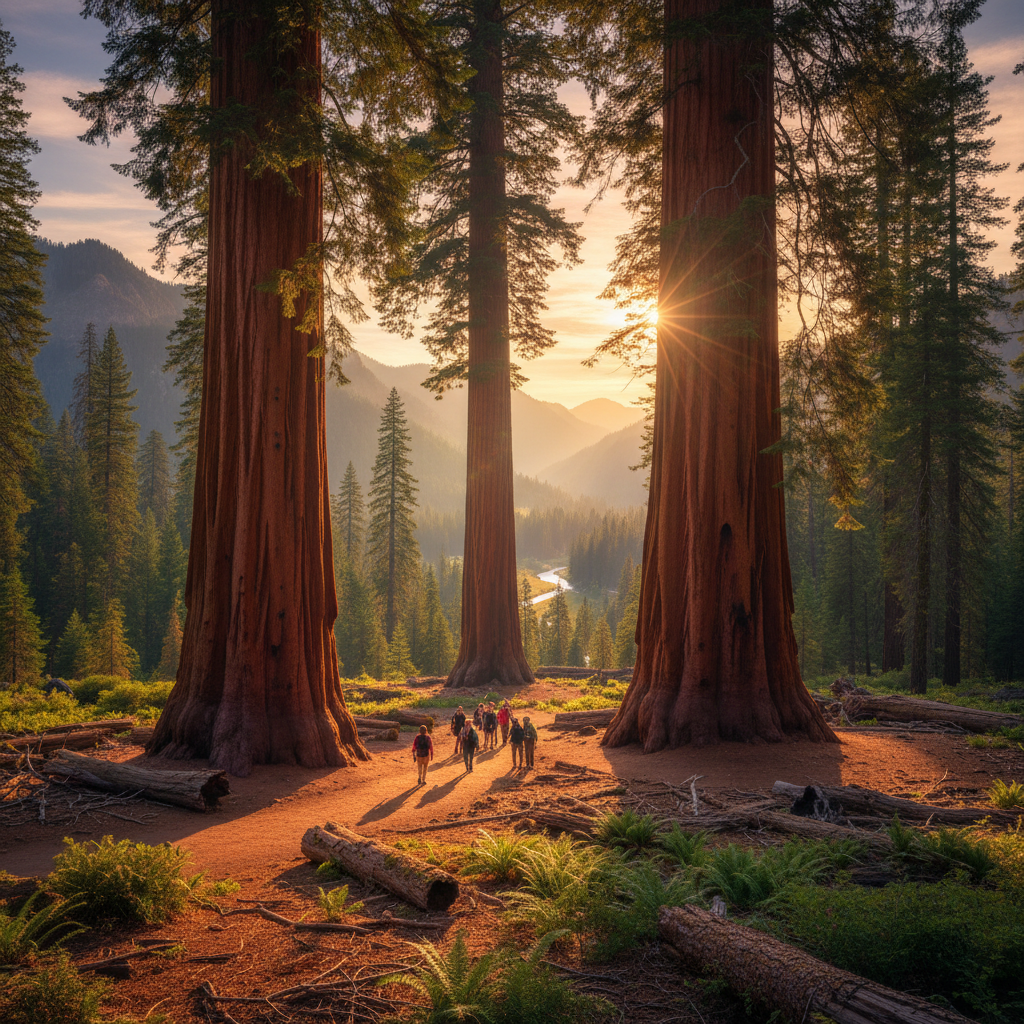
Stand among the world's largest living trees in the shadow of the Sierra Nevada, where ancient sequoia groves meet soaring granite domes and deep alpine valleys.
Sequoia National Park, established on September 25, 1890, as America's second national park, was the first federal reserve created specifically to protect a living organism. Encompassing over 400,000 acres of the southern Sierra Nevada, the park is defined by its dramatic elevation span, rising from the oak-studded foothills of the Kaweah River canyon to the high alpine crest of Mount Whitney. At the heart of the park lies the Giant Forest, a high-altitude plateau home to some of the largest trees on Earth. Winding up the Generals Highway, the transition from chaparral to a cathedral of cinnamon-barked giant sequoias is marked by a sudden drop in temperature and a quietness muffled by massive trunks. At the center of this ancient grove stands the General Sherman Tree, the world's largest living thing by volume. Standing at 275 feet tall with a base diameter exceeding 36 feet, this colossal specimen has survived more than two millennia of wildfires, droughts, and winters, its thick, spongy bark glowing with a warm copper hue when afternoon light filters through the canopy.
The ecology of these ancient giants is intimately tied to the granite landscape and the natural cycle of fire. Sequoia cones require the intense heat of forest fires to open, releasing their seeds into the nutrient-rich ash beds below. Long before the park was designated, the Monache and Yokuts peoples inhabited these steep canyons, gathering acorns and utilizing bedrock mortars that remain visible today at sites like Hospital Rock along the Kaweah River. Beyond the shaded groves, the park's topography rises sharply into the vertical wilderness of the Great Western Divide. Moro Rock, a massive granite dome towering at 6,725 feet, offers a window into this high-country geology. Visitors can ascend a steep, 350-step staircase chiseled into the granite by the Civilian Conservation Corps in the 1930s, arriving at a summit that reveals the deep canyon of the Middle Fork of the Kaweah River framed by the jagged peaks of the Sierra crest. Near the base of the dome, the historic Giant Forest Museum, designed in 1928 by architect Gilbert Stanley Underwood, provides deep historical context on the park's early conservation battles.
Experiencing the true depth of Sequoia requires moving at a slower, more deliberate pace. While crowds gather around the base of General Sherman, the two-mile Congress Trail loop offers a quieter retreat into the forest, leading through clusters of massive sequoias known as the Senate, House, and President groups. For a rugged and remote encounter, the narrow, partially unpaved Mineral King Road twists for 25 miles through nearly 400 curves to a subalpine valley at 7,500 feet. Surrounded by an amphitheater of peaks exceeding 11,000 feet, Mineral King is a place of raw alpine beauty where yellow-bellied marmots are notorious for chewing on vehicle radiator hoses and wiring harnesses during the spring. Whether watching the evening light paint the granite of Moro Rock a deep rose-gold or walking through the silent, mist-shrouded paths of the Giant Forest in the early morning, the park offers a profound encounter with a landscape measured not in seasons, but in centuries.
To escape the crowds at General Sherman, arrive before 8:00 AM or walk the Congress Trail loop, where the forest quiet returns. If you are driving the Mineral King road in spring, wrap the undercarriage of your car in chicken wire to protect vital hoses from salt-craving yellow-bellied marmots.